
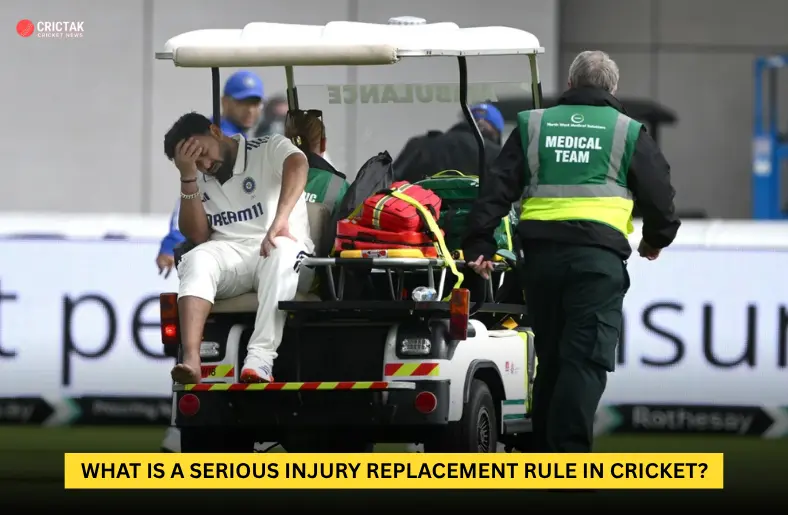
You might be familiar with the rules regarding fielding substitutes and even concussion substitutes. They are meant to permit teams to rotate injured players with other players on the bench.
However, there is a drawback. These rules come with limits.
A concussion replacement, for example, can only take place if the player actually gets hit on the head.
And fielding substitutions? The teams are allowed to change the player only for the fielding position. That’s all. The replaced player cannot bowl or bat.
This situation makes it difficult for the teams when a player has a serious injury that is not a concussion. The teams have to play either with the injured player or without him/her as there is no other option available to them.
However, this situation may not last for long. The BCCI has come up with the ‘serious injury replacement’ rule for its domestic cricket tournaments.
What Exactly is a Serious Injury?
To begin with, teams cannot replace any injured player. Only a serious injury will lead to a successful replacement.
And serious injury includes:
1. Fracture
2. Dislocation
3. Deep Cut
4. Or any other major external injury
The player must have suffered one of these injuries as a result of an external force. It has to be the most important that the injury occurrence was during an active match and it was so severe that it left the player sidelined for the rest of that particular match.
What actually occurs after the player gets serious injury?
At the moment when a player receives a serious injury, the umpires on the field will evaluate the injury’s degree.
They might involve the referee of the match and the medical doctor on the field to consider the injured player’s participation for the rest of the match.
After it has been established medically that the player is not fit to continue, the rule allowing replacement of the seriously injured player will be active.
In What Way will the Rule Operate?
For substitution of a seriously injured player, the team manager should send a request for the replacement to the referee.
The team manager will have to identify the seriously injured player and the incident through which the injury happened. He/she also has to state that the affected player will not participate in the remaining match. And lastly, the name of the replacement player has to be provided.
Then the referee will evaluate the request and if it is considered appropriate, then they will grant the replacement.
But, Who is going to take the Place of the Injured Player?
This part is definitely interesting. The regulation provides for a substitute of similar nature only.
Thus, in case a bowler gets a serious injury, another bowler can be the substitute. A bowler cannot be changed with a batter and vice versa.
In case of an all-rounder, the match referee will have to consider what the injured player’s role would have been (batting or bowling or both) in the remaining part of the game. A similar replacement will, then, be allowed based on this consideration.
Furthermore, it is only from the list of your named substitutes at the time of the toss that teams can choose a replacement. A new player cannot be called from outside the nominated pool.
The only exception is for the wicketkeepers. If a keeper receives a serious injury and there is no backup in the substitute pool, then the team can select someone from outside the nominated substitutes.
The injured player will not play any longer, but the penalties or suspensions they have subjected to will be transferred to the replacement player.
What is the Need for a New Rule?
Unfortunately, there have been cases when players got killed on the field, which then, of course, made them unavailable for the match. This, in turn, forced the team to change their strategy.
An instance is Chris Woakes. He dislocated his shoulder while fielding during The Oval Test with India. As a result, he was not able to bowl for the rest of the match and batted only once.
Woakes’ injury might have been one of the reasons for England to lose the game by six runs. If there had been a substitute, England might have won that match without any difficulty.
There are divided opinions regarding the replacement rule, but If the BCCI manages to implement it properly, we may see it soon at the international level.
